
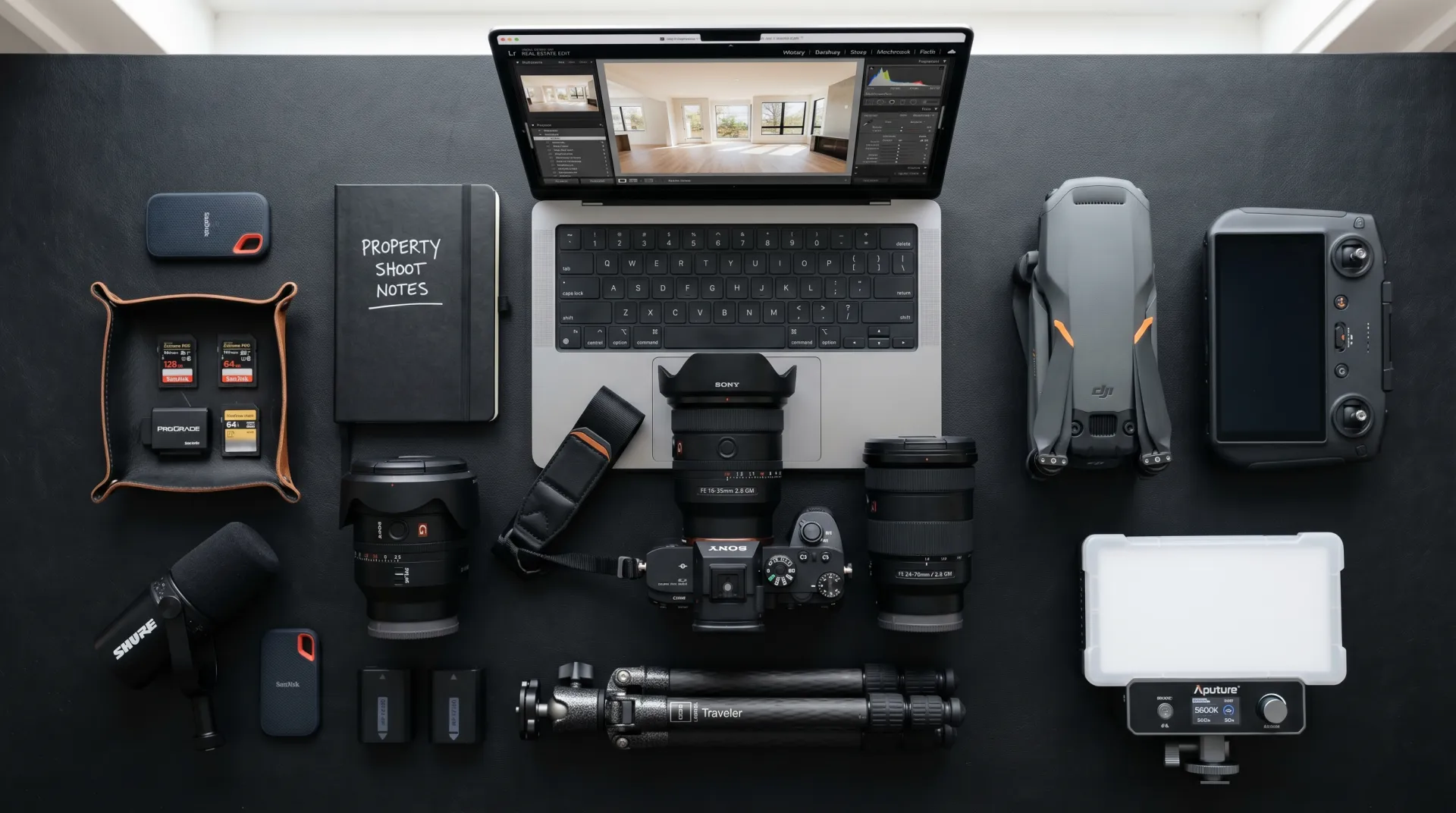
Best cameras for real estate photography: 2026 picks
Most agents obsess over staging, lighting apps, and listing copy. They'll spend hours perfecting the floor plan description and five minutes selecting the camera. That order of priority is backwards. Choosing the best camera for real estate photography is where image quality either starts strong or gets compromised from the first frame. The body you shoot on determines whether a listing reads like a premium editorial campaign or a rushed walkthrough, and post-processing can only do so much to rescue a flat, noisy RAW file from a sensor that wasn't built for interior work.
Choosing the right camera for real estate photography isn't about buying the most expensive body on the shelf. It's about matching sensor performance, lens compatibility, and bracketing workflow to what property interiors actually demand. Bright windows blowing out against dark corners, cramped rooms that need to read spacious, twilight exteriors that require clean high-ISO files, these are the technical problems a camera either solves or doesn't. Studios like 101 Studios pair pro-grade camera systems with a full cinematic production pipeline precisely because the body alone doesn't make the image. The pipeline does. But the body is where it starts.
This guide covers the best cameras for real estate photography in 2026, ranked by budget, with honest trade-off notes on sensor size, mirrorless versus DSLR, wide-angle lens options, HDR bracketing specs, and when a 360 camera belongs in the kit.
What actually makes a camera right for real estate work
Sensor size, dynamic range, and the interior lighting problem
The core challenge in every real estate interior is the same: you're trying to expose for a bright window and a shadowed corner in the same frame. Without enough dynamic range, one end blows out completely. Full-frame sensors with 13 to 14+ stops of dynamic range, like the Sony A7 IV's measured 14.7 EV at base ISO, give you the latitude to recover both window detail and shadow depth in post. Smaller APS-C sensors deliver closer to 12 stops. That difference is visible in the final file, especially when merging HDR brackets. For practical guidance on how to match a camera to specific job requirements and workflows, see this resource on selecting the right camera for the job.
Why wide-angle lens compatibility shapes your buying decision
Most property photographers work at 14 to 24mm (full-frame equivalent) to make rooms read larger without pushing into fish-eye distortion. That focal length range is non-negotiable for tight interiors. The problem: not every camera mount gives you access to quality wide-angle glass at that end of the spectrum. A body's lens ecosystem matters as much as its sensor. Before committing to a system, confirm the mount has at least one sharp, low-distortion wide zoom available at a price point that fits the overall kit budget. Also keep in mind that you don't always need to go ultra-ultra-wide, sometimes a modest wide angle and strong composition outperform extreme glass that introduces distortion.
Full-frame vs. crop sensor: which one fits your workflow
Where full-frame pulls ahead on interior shoots
Full-frame sensors deliver cleaner high-ISO files, greater dynamic range for HDR merging, and more natural rendering of wide-angle focal lengths. For high-end listings where window detail, shadow recovery, and low-noise night exteriors are non-negotiable, full-frame is the professional standard. The Sony A7 IV and Nikon Z6 III are among the most commonly cited professional choices in this category: the Sony delivers a measured 14.7 EV of dynamic range, while the Z6 III competes closely on stabilisation and high-ISO performance. Both include in-body stabilisation and reliable multi-shot AEB support. When a listing is priced above market average, the difference in file quality is worth the investment.
When APS-C is the smarter buy
A crop sensor isn't a compromise for every shooter. For photographers building their first kit, or for agents who need solid listing photos rather than campaign-level imagery, an APS-C body gets the job done. The Canon R50 paired with an RF-S 10-18mm delivers wide-angle capability, beginner-friendly controls, and genuinely usable output for web and social media. At web display sizes, the image quality gap between a well-exposed APS-C file and a full-frame file shrinks considerably. The argument for APS-C is budget efficiency, not settling.
Best camera for real estate photography in 2026, ranked by budget
Budget picks under $900: capable without the commitment
The Canon R50 with the RF-S 10-18mm is the clearest budget recommendation available right now. Wide-angle capable, lightweight, and built for the mirrorless ecosystem, it handles typical listing conditions well and leaves room in the budget for a decent tripod. For photographers who want manual controls and access to a mature lens library at lower prices, the Canon EOS Rebel T7 (around $480 with kit lens) pairs cleanly with the EF-S 10-18mm for genuine wide-angle coverage. Neither body delivers full-frame dynamic range, but both produce listing photos that perform on MLS and social without embarrassment.
Mid-range workhorses ($900 - $2,000): where most pros live
The Sony A7 V is our top overall best pick for 2026. For shooters who prioritise handheld HDR workflows, upgraded processing, and future-proofed capabilities, the A7 V is an undisputed powerhouse that dominates the mid-range professional tier.
The Sony A7 IV is also a standout pick in this range. Its 33MP full-frame sensor, 14.7 EV dynamic range, dual card slots, in-body stabilisation, and 9-shot AEB bracketing cover every real estate workflow demand in a single body. Current pricing sits around $1,998, down from its original launch price. The Nikon Z6 III competes closely on stabilisation and high-ISO performance, and the Canon R6 Mark II earns its place for fast autofocus and excellent colour rendering that reduces editing time. For an in-depth look at real-world handling and performance, consult the Tom's Guide review of the Sony A7 IV.
Pro-grade bodies for serious listing work ($2,000+)
The Nikon Z8 is the benchmark for high-volume professionals. Its 45.7MP stacked full-frame sensor, top-tier autofocus reliability, and consistent output under pressure make it the body of choice for luxury listing work and multi-property shoot days. The Canon R6 Mark III serves photographers who split time between stills and cinematic walkthrough video; it handles both without requiring two separate setups. At this investment level, the return isn't purely about resolution numbers. It's about the reliability and file quality that lets post-production move faster and deliver a consistent editorial standard across every listing.
Mirrorless vs. DSLR for property shoots
Where mirrorless wins for real estate day-to-day
The electronic viewfinder is the practical advantage that matters most in real estate interiors. With an EVF, you see the actual exposure before the shutter fires, which speeds up metering decisions in rooms with mixed or tricky lighting. Mirrorless bodies are also noticeably lighter on multi-property shoot days, reducing fatigue without sacrificing output quality. Industry trends show a clear majority of professional real estate photographers have shifted to mirrorless systems in recent years, driven largely by practical factors: faster workflow, real-time exposure feedback, and native access to increasingly strong wide-angle lens options in modern mounts.
When a DSLR still holds its ground
Battery life is the DSLR's clearest structural advantage. Optical viewfinders draw far less power than always-on EVF displays, which translates to longer shoot sessions without battery swaps. For photographers already holding a full EF or F-mount lens library, the argument to switch to mirrorless is about future-proofing and workflow, not an urgent image quality gap. At a professional level, a Canon 5D Mark IV or Nikon D850 still produces files with the dynamic range and detail that real estate work demands. The switch to mirrorless makes sense when a shooter is building from scratch or when the EVF workflow advantage outweighs the transition cost.
Wide-angle lenses, HDR bracketing, and the 360 camera question
The focal lengths and lenses that actually work for interiors
For full-frame shooters, the working range is 14 to 24mm. Strong picks include: Tamron 17-28mm f/2.8, lightweight with sharp corners. Canon EF 16-35mm f/4L IS USM, optical stabilisation, excellent in low light. Sony FE 16-35mm f/2.8 GM, corner sharpness and fast autofocus. For APS-C systems, the Canon EF-S 10-18mm f/4.5-5.6 IS STM and Nikon AF-S DX 10-24mm f/3.5-4.5G cover the equivalent focal range at lower cost.
One clarification worth making: aperture matters less than sharpness and distortion control for this work. Most real estate interiors are shot in the f/5.6 to f/11 range, so a sharp f/4 lens will typically outperform a softer f/2.8 option when it comes to corner-to-corner detail.
HDR bracketing: what camera specs to check before you buy
When evaluating a body for interior HDR work, three specs matter: multi-shot AEB support (3 to 9 frames), flexible EV step increments, and RAW file output for proper HDR merging in post. The Sony A7 IV (9-shot AEB), Canon R6 Mark II, and Nikon D850 all deliver this reliably. HDR bracketing capability matters more to real estate output quality than raw megapixel count. A 33MP file with a merged 9-shot bracket will typically recover window-to-shadow transitions more effectively than a single-exposure 45MP file, regardless of how aggressively the file is processed afterward.
360 cameras and virtual tours: a different tool for a different job
The Insta360 ONE RS 1-Inch, Ricoh Theta Z1, and Ricoh Theta X are purpose-built for virtual tour workflows. They offer auto-stitching, built-in HDR, and direct mobile upload to tour platforms, features that prioritise speed and convenience over image quality. In terms of raw output, a stitched DSLR panorama with manual bracketing outperforms any 360 camera in dynamic range, sharpness, and noise control. But 360 cameras solve a different problem: according to real estate listing studies, properties with virtual tours attract significantly more online views and hold buyer attention considerably longer than standard photo sets. For a practical walkthrough on implementing immersive tours, consult this 360 real estate photography guide. These tools are a complement to your main camera system, not a replacement for it.
Why great cameras still need a great pipeline behind them
The gear ceiling most shooters hit without realising it
Camera bodies and lenses set the ceiling on image quality. They don't guarantee professional results on their own. Lighting decisions, shot composition, colour grading, and post-production discipline determine whether a listing reads as editorial or merely adequate. A pro-grade body in the hands of a photographer who doesn't understand interior lighting still produces mediocre listing photos. The gear provides the capacity. The workflow delivers the outcome.
Where the cinematic look actually comes from
This is the part most gear guides skip. Studios like 101 Studios invest in top-tier camera systems, but those systems run through a full cinematic production pipeline: creative direction before the shoot, controlled lighting on location, precise colour grading in post, and cohesive editing that makes every deliverable read as part of a campaign rather than a collection of property snapshots. That's the difference between listing photos that document a home and listing imagery that sells one. For individual photographers building their workflow, the camera body is the foundation. For clients who want that editorial standard delivered consistently, partnering with a studio that already runs that pipeline is often the more effective investment than chasing the next body release.
Choosing the best camera for real estate photography: making the right call for your kit
The best camera for real estate photography is the one that matches your budget, your lens investment, and the type of shoots you run most often. Full-frame for high-end listings and HDR-heavy interiors. APS-C for budget-conscious builds where web-sized output is the primary deliverable. Mirrorless for day-to-day workflow efficiency and live exposure preview. A dedicated 360 camera when virtual tours are part of the package. None of these choices are permanent, and none of them are wrong for the right context.
Gear sets the quality floor. Creative decisions and post-production discipline lift listing imagery into something buyers actually remember. Industry research consistently shows that professionally photographed homes sell faster and generate significantly more online views than listings shot on standard equipment. That gap isn't about which body was used. It's about the entire production approach behind the camera.
If you're building your own kit, start with the sensor size and lens ecosystem that fits your current workflow and upgrade around a clear bottleneck. If you're looking for that campaign-level standard without building the production infrastructure yourself, 101 Studios handles the entire pipeline, from shoot strategy to final deliverables, for agents and developers who need imagery that performs.
Get a quote matched to your listing
101 Studios makes every home exceptional. Cinematic photography, film, and drone that turns any Sydney listing into one buyers can't scroll past. Serving all of Sydney.
Book 101 Studios